Our Latest Articles
What Health Coach Training Never Taught Us
The hidden work, customer journey gaps, and operational blind spots that make coaching businesses harder to sustain
I remember thinking that once I became a health coach, the biggest challenge would be finding clients.
And to be fair, that's a pretty significant challenge. Without clients, there is no coaching business. Finding them requires learning to network, build relationships, talk about your work, and put yourself out there in ways that can feel deeply uncomfortable. Many coaches spend years figuring that part out.
What surprised me was what happened after I started getting clients.
That's when I discovered an entirely different set of challenges, ones nobody had really prepared me for. Not about coaching. Not about marketing.
About operating a business.
The Second Climb Nobody Talks About
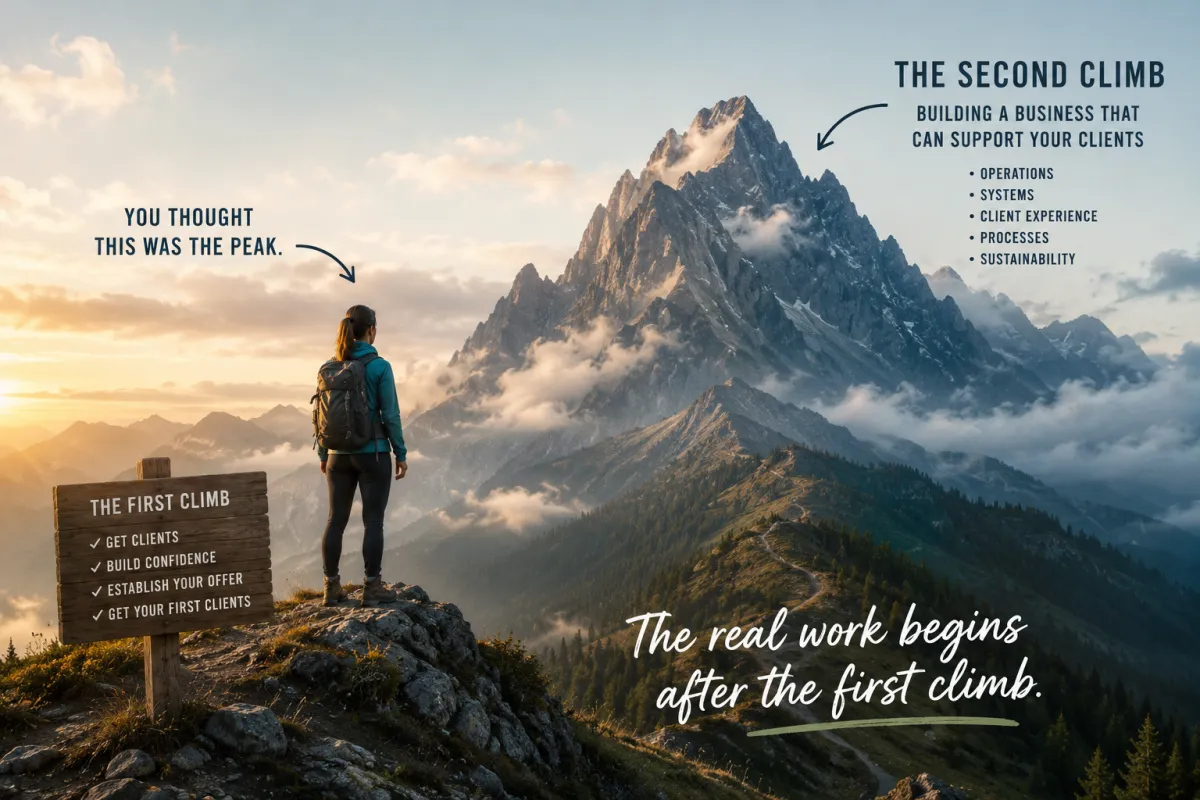
For many coaches, the first climb is getting clients. The second climb is creating a business that can actually support them.
Looking back, I spent years preparing for the first climb. I learned coaching skills, earned certifications, attended conferences, and worked on building confidence. What I didn't realize was that once clients started arriving, I would need an entirely different set of skills to support them effectively.
At first, everything feels manageable.
One client.
Then two.
Then three.
You can remember where things are, who needs what, which email to send and which forms need to still be completed.
Then something changes.
More clients mean more moving pieces, more communication, follow-ups, scheduling. You start leaning on sticky notes and google tasks, and that is when hidden works starts showing up.
The Work We Never Planned For
When most people imagine running a coaching business, they picture the coaching sessions.
What they don't picture is everything surrounding those sessions. Maybe it's the contract a client can't locate before a session. Maybe it's the intake form that never got completed. Maybe it's the reminder you're pretty sure went out, but can't quite confirm. Individually these things seem small. Collectively they create friction.
Not because you're doing anything wrong. Because the business has grown more complex than memory alone can manage.
The Customer Journey Most Coaches Never Review
Here's something that took me longer than I'd like to admit to recognize: I had spent years sharpening my coaching skills, but almost no time examining what the experience of becoming my client actually felt like.
What happens when someone says, "I'm interested"?
How easy is it to schedule? What do they receive after they book? Are expectations clear before the first session? Where do people get confused or quietly disappear?
Most coaches genuinely care about their clients. But very few have intentionally walked through their own business from the client's point of view. I hadn't.
The Difference Between Having a Process and Knowing Your Process
For a long time, I told myself I had systems. And technically, I did:
Contracts
Scheduling software
Intake forms
Email tools
Google Drive and Dropbox
A course platform
A community group
But if someone asked me for something unexpectedly, I was searching. Trying to remember where I'd put it. And when I couldn't find something, I'd just rebuild it from scratch.
Sound familiar? How many times have you recreated something because it was faster than finding the original?
The problem wasn't that I lacked tools. The problem was that my business still lived largely in my head and that created its own hidden workload.
Why Hiring Doesn't Automatically Fix This
At some point I thought bringing on help would solve it. What I learned is that hiring reveals where clarity is missing it doesn't create it.
You can't delegate confusion. You can only delegate clarity.
If your process isn't documented, someone else can't follow it. If your customer journey isn't defined, someone else can't improve it. If your business runs on memory, it will keep running on memory — no matter how many people you add.
The Real Sustainability Gap
We talk about sustainability constantly with our clients. We rarely talk about it with ourselves.
Not six-figure sustainability. Not seven-figure sustainability. Just: does this business support your life, or does it compete with it?
Can you take a vacation without things unraveling? Can you onboard a new client confidently? Does growth create capacity or just more chaos?
Many of us left corporate careers for exactly this kind of freedom. But if we're operating at max capacity with no margin, that freedom stays out of reach.
What I've Come to Believe
I don't think most coaches are bad at business. I think most of us have an operational clarity problem.
We know how to coach. We know how to help people change. What we often don't see clearly is how our own business actually operates, where everything lives, how clients move through our process, and what's quietly creating more work than it needs to.
Finding clients will always matter. It is often the first climb every coach faces.
But building a business capable of supporting those clients may be the climb we spend far less time talking about.
And yet, it's often the climb that determines whether we can keep doing this work for years to come.
The goal was never just to build a business that depends entirely on you. It was to build something that can grow beyond you.
And that starts with being able to see it clearly.

Quick Links
Contact Us
502 W 7TH ST STE 100
ERIE, PA 16502