Our Latest Articles
What Losing Control of a Facebook Page Taught Us About Business Continuity
Every business has defining moments.
Sometimes they're exciting milestones. Other times, they're unexpected setbacks that completely change the way you think.
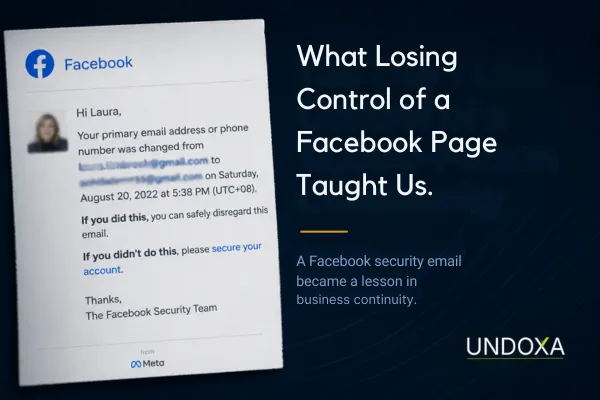
For Laura Timbrook, Undoxa's Chief Technology Officer, that defining moment came when her personal Facebook account was compromised.
Losing her personal account was difficult enough, but the larger impact was what happened next. The business page she had spent years building, growing a community of more than 12,000 followers, promoting a podcast, connecting with clients, and creating speaking opportunities—was no longer under her control.
The page still exists today.
But it no longer belongs to the business that built it.
Despite following every available recovery process, access to the page was never restored. Years of content, community building, and momentum disappeared almost overnight to someone else.
Looking back, it became clear that it was actually a business continuity problem.
The Difference Between Borrowing and Owning
Most businesses rely on technology every day.
Social media.
Email marketing.
Scheduling software.
Payment platforms.
Course systems.
Communities.
Customer relationship management tools.
These platforms are incredibly valuable, but they all have one thing in common.
You use them.
You don't own them.
The platform provider controls the infrastructure, policies, features, and ultimately access to the service.
Ultimately, you're trusting that platform to protect the community you've worked so hard to build. Most of the time that trust is well placed—but it's still a risk that isn't entirely yours to control.
The Lesson We Built On
Laura's Outspoken Nutrition page was taken over years before Undoxa was founded, but the lesson stayed with her.
It wasn't that social media was bad.
In fact, social media remains one of the best ways to connect with people, share ideas, and build relationships.
The lesson was that communities built exclusively on someone else's platform are never completely yours.
Policies change.
Algorithms change.
Accounts can be suspended or compromised.
None of those things are within your control.
That experience reinforced something we still believe today: social media is an incredible place to start relationships, share ideas, and build a following. But it shouldn't be the only place your community exists. Businesses should also create spaces they own, control, and can continue to grow regardless of what happens to a public platform.
Why That Matters at Undoxa
That philosophy is reflected throughout Undoxa.
When we help organizations build communities, courses, and customer experiences, our goal isn't to replace social media. It's to help businesses create a home for the relationships they work so hard to build, one they control and can continue.
We're helping businesses create a place where they own the relationship with their audience.
That's also one of the reasons Undoxa is built on an enterprise-grade platform. We wanted a foundation designed for long-term stability, redundancy, and scalability rather than relying on a collection of disconnected tools.
No technology is immune from change.
Every platform carries some level of risk.
But thoughtful architecture, reliable infrastructure, and business continuity planning can dramatically reduce that risk.
Technology should support your business, not become the reason it stops.
Building a Business That Can Withstand Change
Experiences like this shape the questions we ask every time we evaluate a new technology or feature.
Rather than simply offering software with the latest features, we ask questions like:
Does this make the business more resilient?
Does it simplify operations or create more complexity?
Does it strengthen the relationship between the business and its customers?
Will this still provide value five years from now?
Technology should simplify operations; not cause us to lose focus on the next latest feature.
The Hidden Cost of Fragmentation
One of the biggest risks we see isn't using the wrong software.
It's relying on too many disconnected systems.
Customer information lives in one platform.
Marketing lives in another.
Documents are stored somewhere else.
Payments happen elsewhere.
Support conversations are scattered across email, text messages, and social media.
Individually, each tool may work well.
Collectively, they can create operational complexity and unnecessary risk.
When information becomes fragmented, the business becomes harder to manage and far more difficult to recover when something unexpected happens.
That's why we believe technology should create clarity, not complexity. The goal isn't to have the most software. It's to have the right systems working together to support the business, even when something unexpected happens.
A Question Worth Asking
Take a moment to think about your own business.
If one major platform became unavailable tomorrow...
Could you still reach your customers?
Would your business continue operating?
Would your team know what to do?
Would you have access to the information you need?
If those questions are difficult to answer, it may be time to evaluate not just the tools you're using, but how your business is built around them.
Because the goal isn't to eliminate risk.
The goal is to build a business that's prepared for it.

Quick Links
Contact Us
502 W 7TH ST STE 100
ERIE, PA 16502