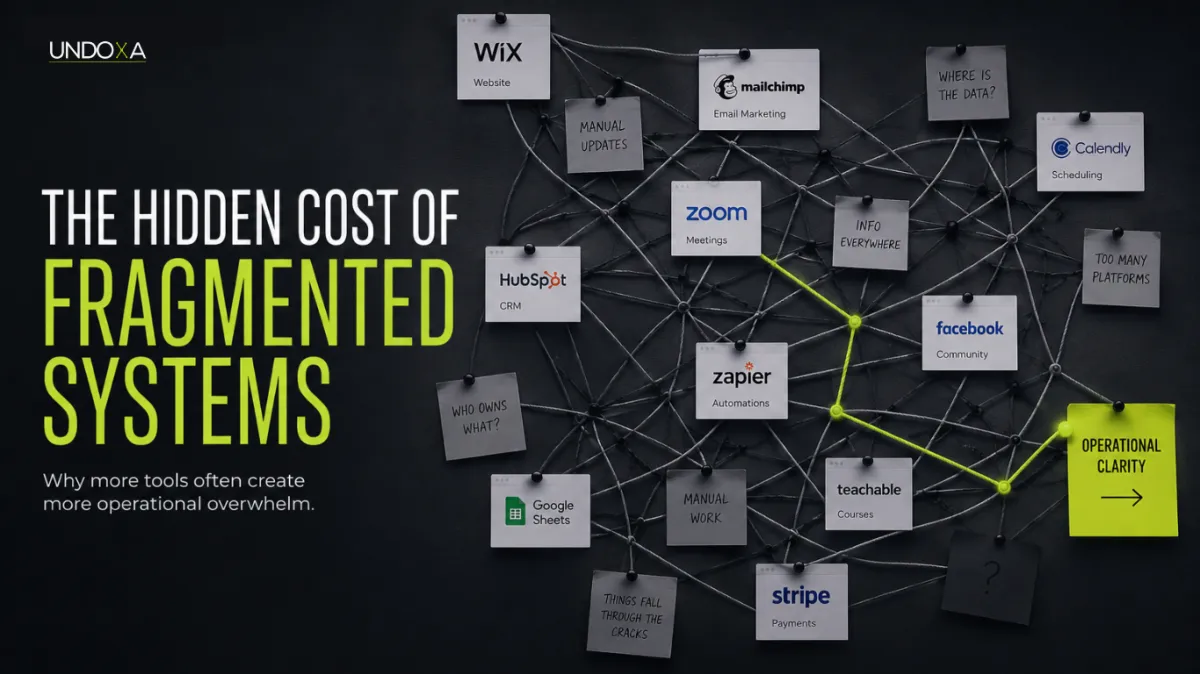
The Hidden Cost of Fragmented Systems | Operational Clarity for Businesses
As a business owner, especially in the early stages, most systems are built out of necessity.
You need a website, so you sign up for Wix.
You need email marketing, so you grab Mailchimp.
You need scheduling, so you add Calendly.
Meetings become Zoom.
You need a CRM, so you try HubSpot.
You want a community, so you create a Facebook Group.
Then someone tells you courses are passive income, so now you add another platform too.
At first, each tool solves a problem.
And honestly, that makes sense.
Most businesses are not built from a master operational blueprint. They are built in survival mode, one decision at a time, one problem at a time, one subscription at a time.
But over time, something else starts happening.
Your business slowly becomes a collection of disconnected systems, subscriptions, workarounds, spreadsheets, automations, and manual fixes held together by memory and effort.
Nothing fully talks to each other.
So you add Zapier thinking it will finally connect everything.
And technically… now the systems ARE talking.
But somehow the noise, confusion, and operational frustration only get louder.
Because the problem was never just the tools.
The problem was fragmentation.
When Every Tool Solves a Problem...and Creates Another One.
At first, fragmentation doesn't feel dangerous.
Honestly, it usually feels productive.
You are solving problems.
Building.
Growing.
Trying to create momentum.
A tool for scheduling here.
A platform for email there.
A CRM.
A booking link.
A Facebook Group.
A payment platform.
A course platform.
A chat tool.
Individually, each one makes sense.
But eventually something shifts.
Your business starts depending less on systems…
and more on your ability to remember how everything works together.
You remember:
where leads are coming from
which Zap is connected to what
why one form sends two emails
which onboarding document is the “correct” one
where client notes actually live
which platform contains the updated pricing
which calendar link should be used
And because you built it piece by piece, it all makes sense to YOU.
But to anyone else?
It looks like operational spaghetti.
That is usually the point where business owners start feeling:
mentally exhausted
constantly reactive
afraid to change anything
buried in notifications
overwhelmed by “small tasks”
unsure where things are actually breaking down
Not because they are bad at business.
But because the business quietly became dependent on complexity instead of clarity.
Operational Tax Businesses Quietly Pay Every Day
Most fragmentation does not show up as one catastrophic event.
It shows up as constant friction.
A slow operational leak businesses adapt to so gradually that eventually it starts feeling normal.
Lost Time
Small inefficiencies compound quickly.
Repeatedly switching between tools. Email, Whatsapp, FB, IG to find messages
Searching for information, or the program you forgot where you "organized it".
Sending out manual reminders
Calling clients who forgot to show up.
Following up on things that “should have happened automatically.”
A few extra minutes repeated hundreds of times eventually becomes hours of operational waste every single week.
Communication Breakdowns
When systems are fragmented, communication becomes reactive instead of intentional.
You begin asking:
“Where is that file?”
“Did this lead get contacted?”
“Which version is correct?”
“Did I schedule the newsletter?”
“Why didn’t the workflow trigger?”
Fragmented operations create uncertainty, and uncertainty creates stress.
Inconsistent Customer Experiences
One of the biggest hidden costs of fragmented systems is inconsistency.
Clients receive different experiences.
Emails are delayed.
Appointments fall through cracks.
Leads go cold.
Follow-up becomes unpredictable.
And often the customer does not see “system fragmentation.”
They simply experience a business that feels disorganized.
The Burnout
This is the part many businesses underestimate.
Operational friction is emotionally exhausting.
Constant context switching, troubleshooting, and reactive work drains cognitive energy.
Feeling overwhelmed not necessarily because the workload is impossible, but because the operational environment lacks clarity.
And eventually, the business starts depending on you or your team over-functioning to compensate for broken processes.
That is not sustainable growth.
That is survival.
Why More Tools Rarely Solve the Problem
One of the biggest misconceptions in modern business is the belief that operational problems are solved by adding more software.
But most businesses are not struggling because they lack tools.
They are struggling because they lack operational clarity.
Technology amplifies what already exists.
If the underlying process is healthy, technology can increase efficiency.
If the underlying process is chaotic, technology often just helps the chaos move faster.
This is why businesses can spend thousands of dollars on:
automation platforms
AI tools
CRMs
integrations
dashboards
productivity systems
…and still feel overwhelmed.
Because automation without clarity rarely creates freedom.
It creates faster confusion.
The Pressure to Automate Everything
Right now, businesses are under enormous pressure to automate.
Everywhere you look, the messaging sounds the same:
automate your business
save time
scale faster
use AI
eliminate manual work
create passive systems
And while automation can absolutely be powerful, there is a part of the conversation that rarely gets discussed honestly:
You cannot automate clarity you do not already have.
Automation requires process.
AI requires structure.
Systems require intentionality.
Otherwise businesses end up layering automation onto operational confusion.
And suddenly the tools that were supposed to create freedom become another thing requiring management, troubleshooting, and constant oversight.
Operational Clarity Changes Everything
At Undoxa, we talk a lot about operational clarity.
Not because it is trendy.
Honestly, it is not a flashy concept.
But operational clarity changes the way businesses function.
Clarity helps businesses:
reduce friction
simplify workflows
improve communication
identify bottlenecks
create consistency
implement automation strategically
support teams more effectively
scale more sustainably
Most businesses do not need more complexity.
They need systems that make sense.
Systems that support the humans behind the business instead of exhausting them.
Because operations influence far more than efficiency.
They shape:
team culture
stress levels
customer trust
visibility
leadership capacity
growth potential
sustainability
And increasingly, operational clarity is becoming a competitive advantage.
The Business That Scale Best Usually Operate the Clearest
The businesses that scale sustainably are rarely the ones chasing every new tool.
They are usually the ones that:
understand how work flows
reduce unnecessary friction
centralize communication
simplify operations
create clear processes
implement technology intentionally
and build systems around how people actually work
That is a very different philosophy than simply adding more automation.
And honestly, I think more businesses are starting to realize that.
Because eventually fragmented systems become too expensive, not just financially, but operationally and emotionally.
Final Thoughts
The hidden cost of fragmented systems is not just inefficiency.
It is exhaustion.
It is reactive operations.
Lost visibility.
Decision fatigue.
Constant context switching.
Communication breakdowns.
Operational overwhelm that quietly drains momentum from a business over time.
And most of the time, the solution is not another tool.
It is clarity.
That is why process matters.
That is why operational strategy matters.
That is why thoughtful automation matters.
Because technology should support the business, not become another layer of chaos inside it.
And maybe that is the real future of sustainable business growth:
Not more noise.
More clarity.