You Can't Scale What Only Exits In Your Head
There was a point in my business when I became convinced I needed help.
Not because I had hundreds of clients. Not because I was running a large operation. I was simply busy — the kind of busy that many coaches know well, and the kind I wrote about in my last post (What Health Coach Training Didn't Teach Us) when I talked about the hidden operational weight that builds up behind the scenes of a coaching business.
This is what I discovered next.
The Irony I Didn't See Coming
My days were filled with creating content, building programs, responding to emails, updating resources, preparing presentations, following up with potential clients, and trying to keep track of everything demanding my attention.
At some point I noticed something ironic: I felt like I was doing everything except coaching. The work surrounding the coaching had grown so large that actual coaching was often the smallest part of my week.
Like many business owners, my first thought was straightforward.
I need to hire help.
I would focus on coaching and program creation. Someone else would handle marketing, lead generation, and all the things I didn't enjoy doing.
The problem came when I tried to figure out what exactly I would hand off.
I knew I was busy. I knew there were tasks consuming my time. What I couldn't clearly explain was how my business actually operated.
What was I selling? How did a prospect move from first contact to becoming a client? What did my marketing process look like?
If I'm being honest, I often created packages on the fly based on what someone asked for. Even when I had a defined offer, I found myself adjusting the scope or tweaking the price just to get to a yes.
My processes didn't just live in my head.
Most of my business did.
Growth doesn't eliminate that problem. Growth exposes it.
For years I thought scaling meant getting more clients. Then I thought it meant hiring help.
What I've come to believe is that neither of those things work if the business depends entirely on the owner remembering, checking, and holding everything together.
When you only have a handful of clients, this isn't obvious. You can usually remember where everything is. You know which forms need updating, which resources belong to which programs, which follow-up email comes next.
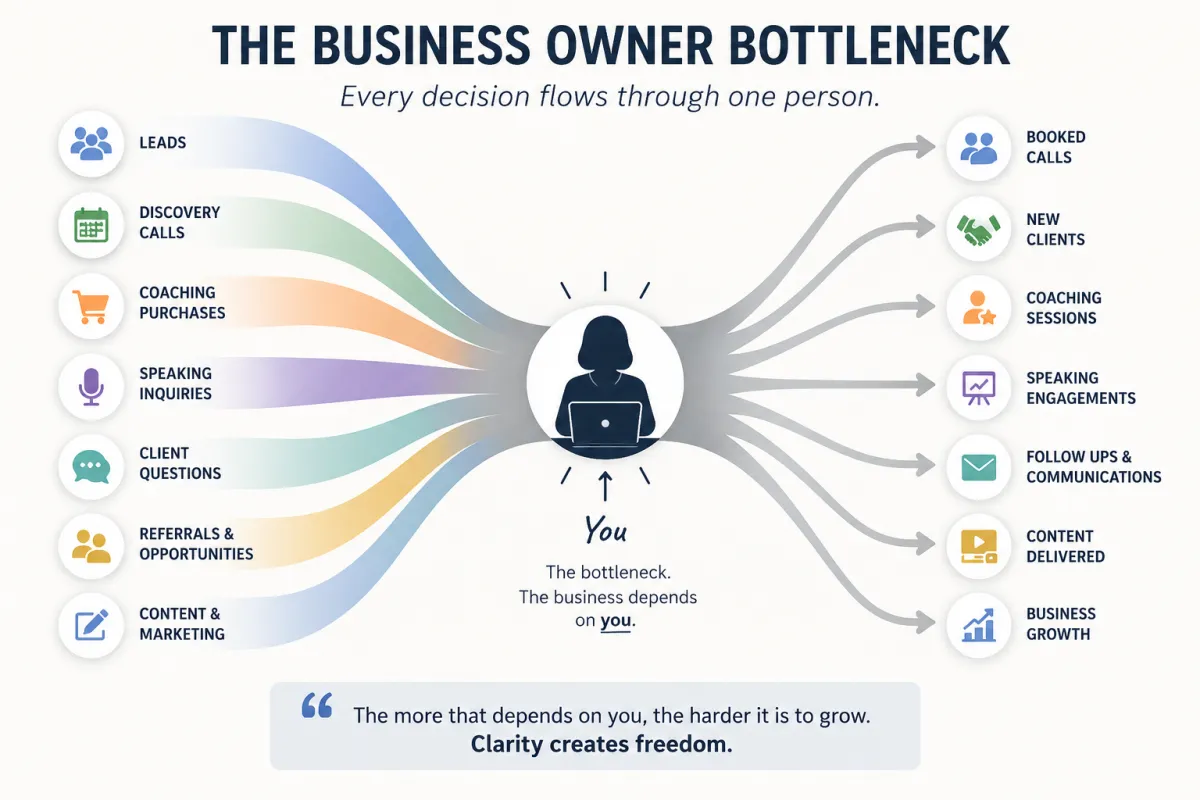
But eventually there comes a point where your brain becomes the bottleneck.
Not because you're disorganized. Not because you're doing anything wrong. Because you've reached the limit of what one person can reasonably carry.
You Can't Delegate Confusion
For a long time, I assumed hiring someone would create the structure my business was missing.
Looking back, I had it completely backwards.
People don't create clarity. Clarity allows people to help.
If I couldn't explain how a client moved through my business, how could someone else support that process? If I was constantly changing pricing, packages, and workflows based on the situation in front of me, how could anyone else know what "normal" looked like?
I wasn't trying to delegate tasks. I was trying to delegate decisions.
And that's much harder.
Tasks can be handed off. Decisions require context, documented processes, clear expectations, a shared understanding of how things work. Without that foundation, every question comes back to the owner. Every exception comes back to the owner. Every decision comes back to the owner.
The business may have more people involved, but it still depends on the same person to keep everything moving.
You can't delegate confusion. You can only delegate clarity.
The Moment in Lake George
I remember the first time I made money while on vacation.
My family was camping at Lake George — the kind of place where cell service disappears completely and it's just mountains, water, campfires, and the people you love.
At one point I drove into town, and as my phone came back to life, two course purchase notifications loaded in.
I had made money while sitting in the mountains with my family.
At first I thought the lesson was about selling courses. Looking back, it wasn't.
The real lesson was that something in my business had worked without me. The sale happened. The payment processed. The customer received what they needed. And I wasn't sitting behind a computer making any of it happen.
That's when my thinking started to shift.
Because what if it wasn't a course? What if someone purchased a coaching package while I was away? What if a potential client scheduled a discovery call, or a speaking inquiry came in and received exactly the information it needed?
What if I came home from vacation and found opportunities already moving forward — instead of waiting for me to return?
That was the moment I realized the real goal wasn't passive income.
The goal was freedom.
The Difference Between Having the Piece and Having a Process
It took me a few years to understand why that moment worked for my courses and felt nearly impossible everywhere else.
The course was easy because the experience was already mapped out. Someone could move from interested, to customer, to student without waiting for me to take the next step.
Coaching was different.
If someone was interested in coaching, there was usually a discovery call. If they decided to move forward, I'd send a contract - except the package had often changed, so I'd update it first. Once signed, I'd send intake forms, then my calendar link, then an explanation of what came next.
There were a lot of steps. And each one depended on me.
At the time I didn't think much of it. I had a contract. I had the forms. I had a scheduler. I had the resources.
What I didn't have was a process that allowed those pieces to work together without me in the middle of every handoff.
I had assumed that was just the nature of coaching. Of course I had to send the contract. Of course I had to explain next steps. Of course I had to manually move people through.
What I eventually realized was that the problem wasn't a lack of tools.
It was a lack of clarity about what happened next.
What happened after a discovery call? After someone said yes? After the contract was signed? After the first session was booked?
Because I hadn't mapped those answers, I had unintentionally made myself responsible for every single step.
The business wasn't dependent on me because it had to be.
It was dependent on me because I was the only one who knew what came next.
What I Have Come to Believe
That was a hard thing to sit with. But it was also freeing.
Because if I could clearly define the process, I could document it. If I could document it, I could improve it. And if I could improve it, I could eventually hand parts of it off — not to remove the human element of coaching, but to remove the unnecessary dependence on me.
The businesses that grow aren't necessarily the ones with the best ideas, the best certifications, or even the best services. They're often the ones where the owner has made the invisible visible. They've taken what lived in their head and turned it into something that can be understood, improved, and repeated.
That's when growth stops depending on memory.
And starts depending on process.That was a hard thing to sit with. But it was also freeing.
Because if I could clearly define the process, I could document it. If I could document it, I could improve it. And if I could improve it, I could eventually hand parts of it off — not to remove the human element of coaching, but to remove the unnecessary dependence on me.
The businesses that grow aren't necessarily the ones with the best ideas, the best certifications, or even the best services. They're often the ones where the owner has made the invisible visible. They've taken what lived in their head and turned it into something that can be understood, improved, and repeated.
That's when growth stops depending on memory.
And starts depending on process.